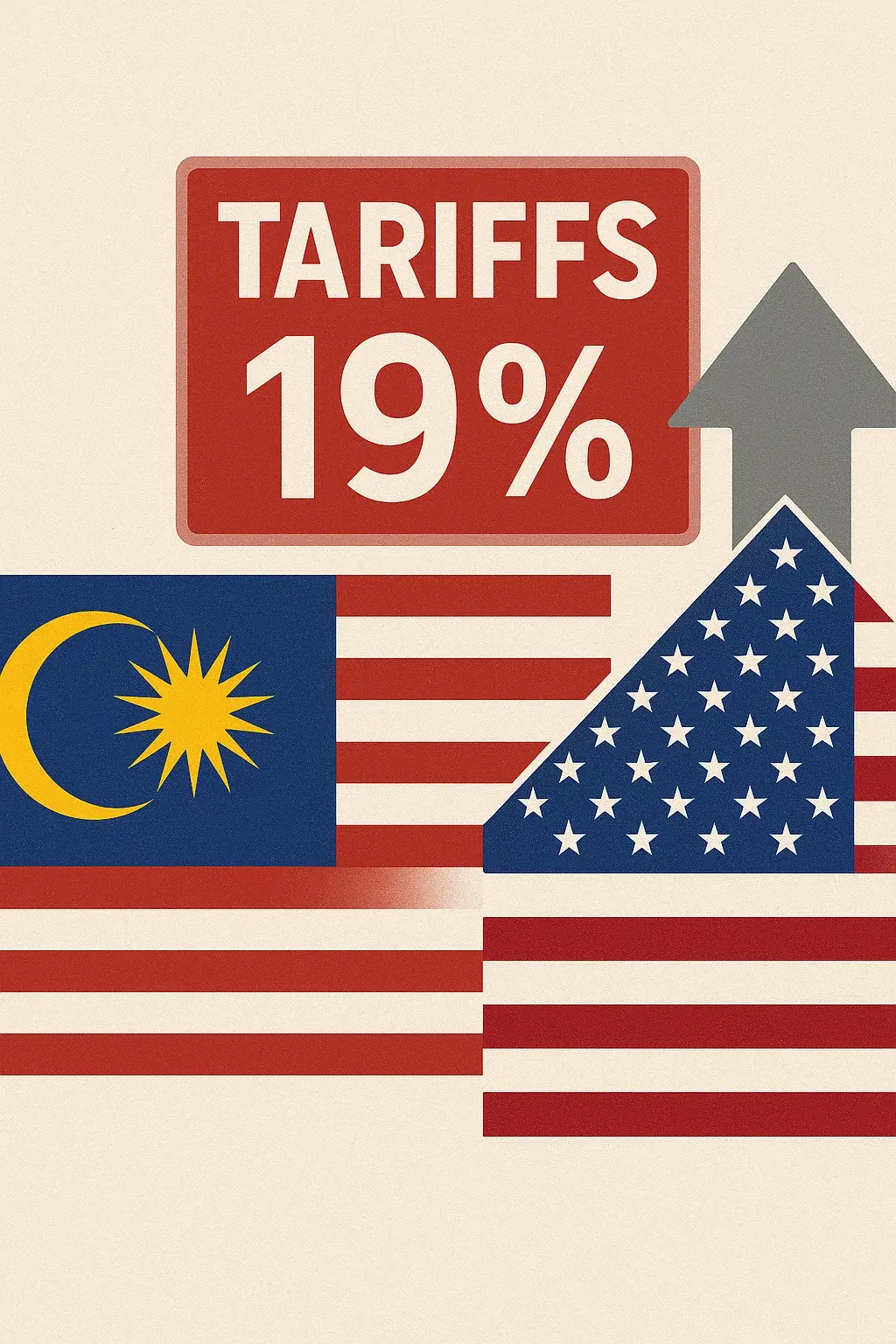
As of 1 August 2025, virtually all Malaysian goods entering the United States now face a 19% ad valorem duty – down from the 25% “shock rate” threatened earlier this year. Pharmaceuticals and semiconductors remain duty-free, but glove-makers, palm-oil processors, furniture outfits and most other industries must absorb or pass on the new cost. The Ministry of Investment, Trade & Industry (MITI) expects the levy to be the “new baseline” and is urging companies to leverage Malaysia’s 18 free-trade agreements and accelerate efficiency upgrades.
Below are the three legal tasks you should complete before your next shipment – plus a heads-up on upcoming guidance for exporters already locked into fixed-price contracts.
1 | What exactly changed?
- Effective date: 1 Aug 2025 – shipments that arrive or are entered for consumption in the US on or after this date attract 19%.
- Coverage: All tariff lines except Malaysian pharmaceuticals and semiconductors, which stay at 0%.
- Legal basis:
- MITI Gazette U.(A) 245/2025 (reciprocal tariff schedule)
- US Federal Register Notice, Vol. 90, No. 149 (to be published 5 Aug 2025)
- Policy signal: MITI frames the deal as a win that preserves “red-line” sovereignty issues and aligns Malaysia with ASEAN peers.
2 | Three immediate customs must-dos
| Scenario |
Duty rate at U.S. border |
Requirements |
Malaysian-made item merely trans-shipped through Canada/Mexico
(relabelling, repacking or other minor handling only)
|
19 % (Malaysian origin) – possible CBP evasion penalties
|
Origin remains Malaysia; no qualifying transformation occurred.
|
|
Product undergoes substantial transformation in Canada/Mexico and meets USMCA rules of origin
|
0 % (duty-free under USMCA)
|
Must satisfy the specific rule of origin in USMCA Annex 4-B (tariff-shift or RVC test) and hold a valid Certificate of Origin.
|
|
Product entered as “Canadian” or “Mexican” but fails USMCA origin test
|
35 % (Canada) or up to 30 % (Mexico) – higher than Malaysia’s 19 %
|
CBP treats it as non-USMCA origin; incorrect declaration risks extra penalties.
|
Tip: Record the additional duty as a distinct cost element in your ERP; it will be required if you later claim refunds under an FTA route.
3 | Fast FAQs for busy exporters
Q 1 – Does the 19% apply to goods that left Malaysia before 1 Aug 2025?
It depends. Duty is levied on the date of entry into the US, not the export date. Time-sensitive cargo on the water may still clear at the old rate if CBP processes the entry before midnight Eastern Time, 1 Aug 2025.
Q 2 – We ship glove components to a plant in Thailand, then re-export finished gloves to the US. Which tariff rate applies?
The Thai export is treated as Thai origin if the processing meets the substantial transformation test (19 CFR § 102.20). Otherwise, US Customs may “look through” to Malaysia and demand 19%.
Q 3 – Are there quick ways to avoid the duty legally?
Two paths:
- CPTPP or RCEP routing where rules of origin can be met;
- qualifying for the US “de minimis” USD 800 personal-use exemption. The latter rarely applies to commercial consignments and was rejected in a recent glove-maker case study we'll publish in Part 5.
Have a different question? Email us and we may feature it in a later instalment.
4 | Medium-term levers
MITI itself is urging SMEs to “make full use of Malaysia’s 18 FTAs to diversify and expand their export markets.” Over the next quarter:
1. Map FTA eligibility: List US customers who could accept goods re-routed via CPTPP partners (e.g., Canada, Mexico).
2. Automate HS/ROO checks: Integrate a rules-of-origin engine into your ERP to flag shipments that already meet a 0% FTA rate.
3. Scenario-model duty impact: Run a landed-cost differential for 19% vs. FTA-zero routes, net of additional logistics and compliance costs.
5 | What’s next? Existing contracts under fire
Coming up next: “Existing Contracts Under Fire – Renegotiation & Risk-sharing Tactics.” We’ll unpack force majeure, hardship and frustration provisions as contractually agreed and as under the Contracts Act 1950, INCOTERMS price-adjustment tools and a step-by-step renegotiation script for SMEs already locked into US supply commitments.
Stay tuned – or subscribe to our mailing list to get the article the moment it drops.
Further reading
Disclaimer
This publication is for general information only and does not constitute legal advice. Circumstances vary; exporters should seek specific counsel before acting.