Overview
In this write-up on the Malaysia–EFTA Economic Partnership Agreement, you will find:
- key trade figures between Malaysia and the EFTA states
- the sectors and legal areas covered by the agreement
- what MEEPA means strategically for companies in Malaysia and EFTA
- links to two practical checklists (EFTA-facing and Malaysia-facing)
- how your company can prepare ahead of MEEPA's entry into force
Background
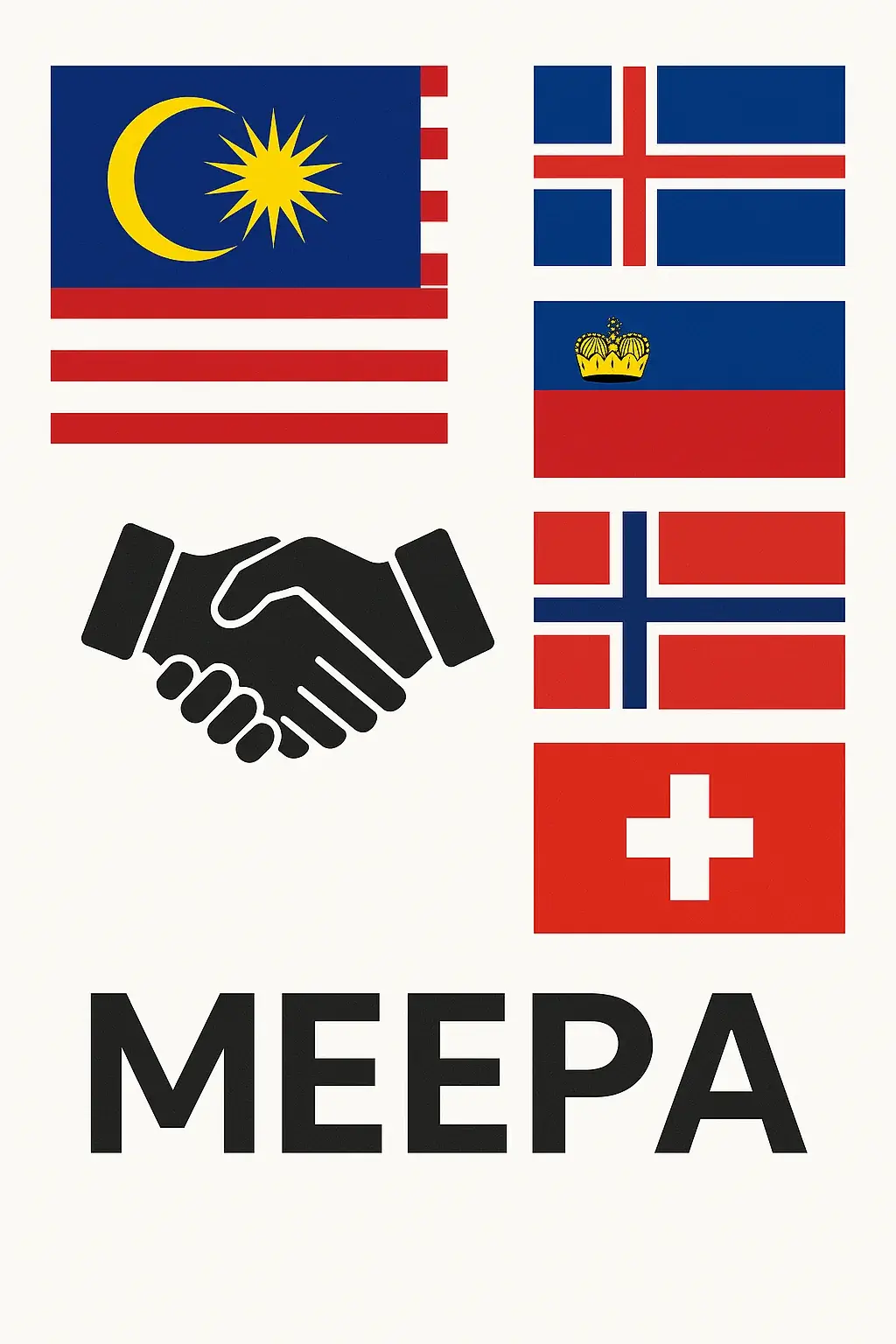
On 11 April 2025, Malaysia and the four member states of the European Free Trade Association (EFTA) – Switzerland, Norway, Iceland, and Liechtenstein – concluded negotiations on a comprehensive Economic Partnership Agreement (MEEPA). After 17 rounds of negotiation, beginning in 2014 and paused between 2017 and 2020, MEEPA now promises to reshape the legal and commercial landscape between the two regions.
A Decade in the Making
The foundation for this agreement was laid in 2010 with a Joint Declaration on Cooperation[1] between Malaysia and the EFTA states. Since then, trade and investment have grown steadily, with total bilateral trade reaching €2.14 billion in 2024. EFTA exports to Malaysia consist mainly of machinery, pharmaceuticals, medical instruments and watches, while Malaysia exports electrical machinery, rubber products, aluminium and palm oil to EFTA markets.
MEEPA aims to formalise and expand this relationship by providing legal certainty, removing barriers to trade, and opening new pathways for investment, services, and procurement.
What Does MEEPA Cover?
While the full text of the agreement has yet to be published, available summaries indicate that MEEPA will include provisions on:
- Trade in Goods: elimination or reduction of customs duties
- Services and Investment: improved market access and protections for investors
Intellectual Property: protection and enforcement of IP rights
- Public Procurement: non-discriminatory access to government contracts
- Sustainability and Development: commitments related to labour, environment, and responsible sourcing (including palm oil)
- Digital Trade and Customs Cooperation: facilitating modern, cross-border trade processes
For companies domiciled in both Malaysian and EFTA, this agreement provides new opportunities to expand operations across borders, with reduced friction and more predictable legal frameworks.
Strategic Relevance: Beyond Tariffs
MEEPA is not just about lowering tariffs. It is about strategic positioning in a shifting global economy. For EFTA companies, Malaysia serves as a gateway to ASEAN and an increasingly important player in China+1 strategies. For Malaysian companies, EFTA states represent highly developed, high-income markets with exacting standards and attractive procurement frameworks.
The agreement also arrives at a time when sectors like halal-certified food, digital services, green technology and advanced manufacturing are becoming focal points of cooperation. Having in mind the significant impact of the tariffs recently imposed by the Trump administration, it is even more welcome.
Our Cross-Border Capabilities
At Aqran & Partners, we are well-positioned to assist businesses on both sides of MEEPA. We regularly advise on:
- cross-border investments and business setups
- trade compliance and customs issues
- contract structuring and dispute resolution
- intellectual property protection and licensing
- public procurement and ESG-linked requirements
We provide legal advice in German, French, and Italian – the official languages of Switzerland – in addition to English and Bahasa Malaysia. Our Senior Foreign Advisor, Dr. Harald Sippel, is an Austrian lawyer who has previously worked across ASEAN and spent time in Oslo, Norway, with the Austrian Trade Commission/Advantage Austria, giving him a nuanced understanding of EFTA perspectives.
Through our network of partner law firms in all four EFTA countries, we are also able to provide seamless cross-border legal support.
What’s Next?
MEEPA has been concluded but not yet signed or ratified. Nonetheless, businesses would do well to prepare now. Anticipating changes in tariffs, services access, and investment frameworks can offer a first-mover advantage.
To support this, we have developed two practical checklists:
We invite you to explore these checklists to understand what MEEPA could mean for your business.
📩 Contact us today if you are planning a trade or investment initiative that may be affected by MEEPA. Our team will be happy to provide tailored legal support.
[1] See www.efta.int/sites/default/files/media/documents/legal-texts/free-trade-relations/malaysia/malaysia-jdc.pdf for the full text.